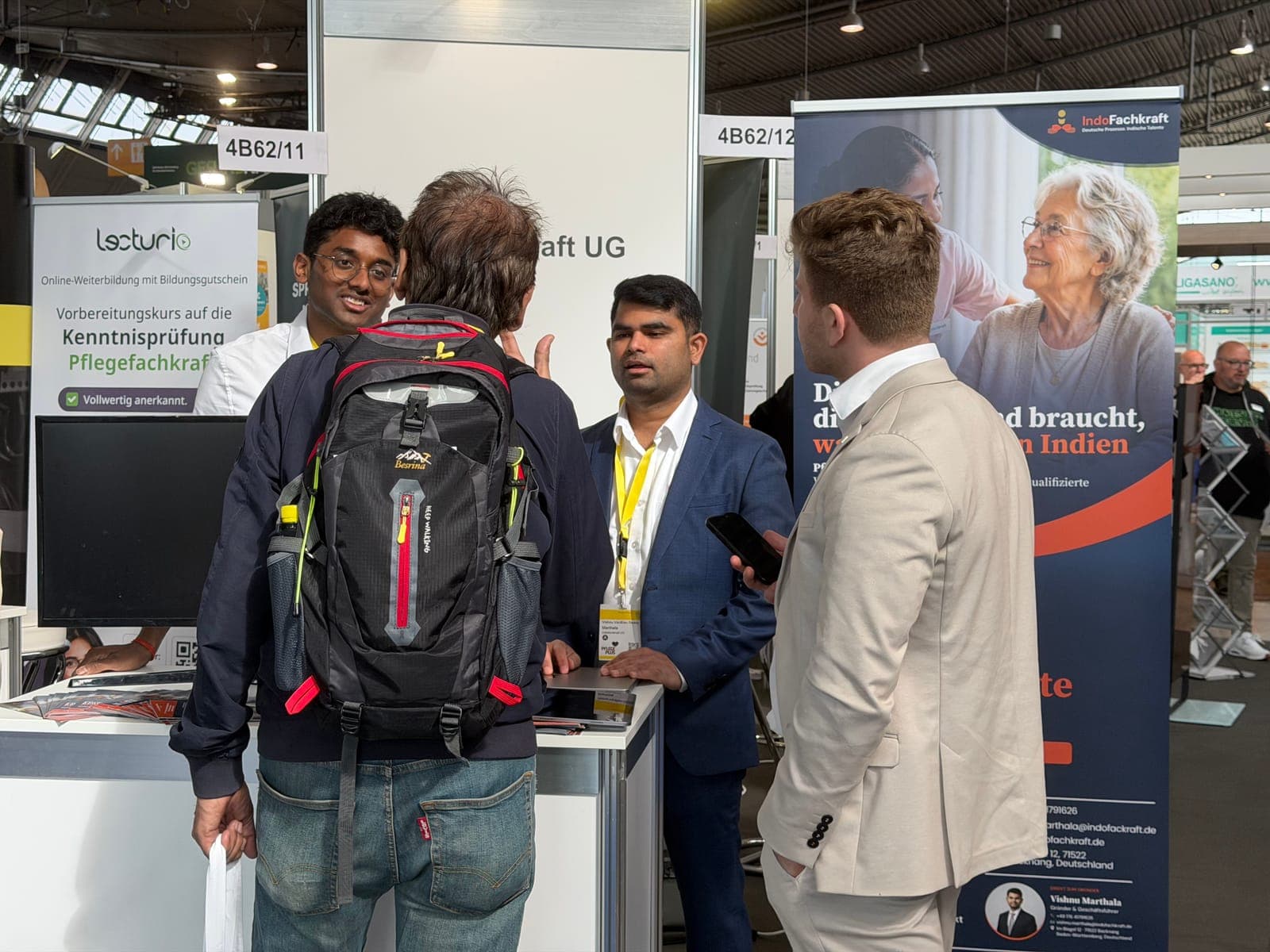
Three days, one bar table, honest sentences
The most important sentence at Pflege Plus 2026 wasn't said on a stage. It was said at a bar table in Hall 6, around 4:30pm on day two, by the nursing director of a mid-sized provider from the Hannover region: "We know we have to recruit internationally. We just don't know whom to trust with it anymore."
That single sentence captures the state of the industry in May 2026. We took down three trends from the conversations we had — commented, not polished.
Trend 1: Recruiting is no longer the problem, onboarding is
The question "can we even recruit internationally?" has been answered. The actually open question is: what happens in the first 90 days after the start date?
In at least four conversations we heard variations of the same finding: The nurse arrives, the visa is fine, the apartment is sorted, the adaptation course is running — and in month three, something breaks. Sometimes the family, sometimes the burden of shift work, sometimes the gap between the promised and the actual salary. The drop-out rate after arrival remains, in providers' perception, the most expensive line item in the entire calculation.
The operational consequence: onboarding doesn't end in week two. It runs at least nine months, with clear responsibilities, documented check-ins, and an escalation path when problems surface. We've started a dedicated piece on this in summer 2026: Onboarding international nurses — the first 90 days.
Trend 2: Providers are talking openly about failed placements for the first time
What's changed in conversational style: nursing directors and HR leads now talk more openly about placements that didn't work. "We've had three attempts behind us" was a sentence that came up several times — and one that, two years ago, would have crossed nobody's lips in that form.
This openness has two effects. First: providers are starting to ask very direct questions in initial conversations — about success rates, about contractual penalties for early termination, about references you can actually call. Second: bad recruiters become visible, because providers talk to each other. The industry isn't professionalising through external control, it's professionalising through internal market transparency.
We've drawn a consequence from this and published our own analysis — three concrete lessons from a failed placement at our company. The piece appeared under the title Three reasons our last placement failed — what we learned.
Trend 3: Differentiation through process quality, not volume
The third observable trend is subtler, but structurally the most important. Two years ago, every booth advertised with the number of nurses placed. In 2026, conversations more often centred on process details:
- What's your authorisation architecture — principal power of attorney with the provider or with the recruiter?
- Where does language training happen — in classrooms in the country of origin or via generic online tools?
- What contracts exist with the language schools?
- How is candidate selection conducted on the ground in India — your own staff or external subagents?
- Are you pursuing the RAL Gütezeichen 912 / GAPA certification?
These questions aren't asked out of academic interest. They're asked because providers have learned that the decisive difference between working and failing placements lies in process architecture. A recruiter who audibly hesitates on the authorisation question is out.
For seriously working recruiters, this development is good. It shifts competition from advertising claims to verifiable substance — and that's the only field on which this industry functions sustainably.
What we take away from Stuttgart
Three takeaways for the coming months:
- More content on onboarding and the first 90 days — because the question "will she arrive" has been replaced by "will she stay"
- Preparing our own application for the RAL Gütezeichen 912 / GAPA — we're working towards it and will document our status transparently (see article)
- Refraining from volume promises — we'd rather commit to three placements that will materialise than eight that won't
If you want the bigger structural context, it's in our Nursing shortage reality check 2026.
Next step
If you want a focused conversation about pipeline planning for the next 18 months — outside the trade-fair bustle — book a 20-minute slot: Book a call.
IndoFachkraft UG (haftungsbeschränkt)
Vishnu Marthala, Geschäftsführer
Im Biegel 12, 71522 Backnang
Amtsgericht Stuttgart HRB 803907
Steuernummer 51047/27615 (Finanzamt Backnang)
IHK Stuttgart Mitgl.-Nr. 2854625
Tel.: +49 176 41791626
E-Mail: vishnu.marthala@indofachkraft.de
Web: www.indofachkraft.de